

Boxers training.
Boxing (ボクシング, Bokushingu), formerly known as Kentō (拳闘) in Japan, is a combat sport in which two participants of the same weight class fight each other with their fists that are under boxing gloves. Someone who partakes in boxing is called a "boxer" (ボクサー, Bokusā). Individuals wanting to partake in boxing join a boxing gym to train and have matches set up for them. Boxing is a dangerous sport, where a single mistake can be the difference between life and death.
There is professional boxing (プロ ボクシング, Puro Bokushingu) and amateur boxing (アマチュア ボクシング, Amachua Bokushingu). In Japan, one has to be age 17 to acquire a pro boxing licence.[1] In order to get a pro license, a boxer must partake in a Pro-Test, where they do a written test before taking on an opponent who is also taking the Pro-Test. The winner receives the C-Class Licence, becoming a professional boxer.
Boxing Match
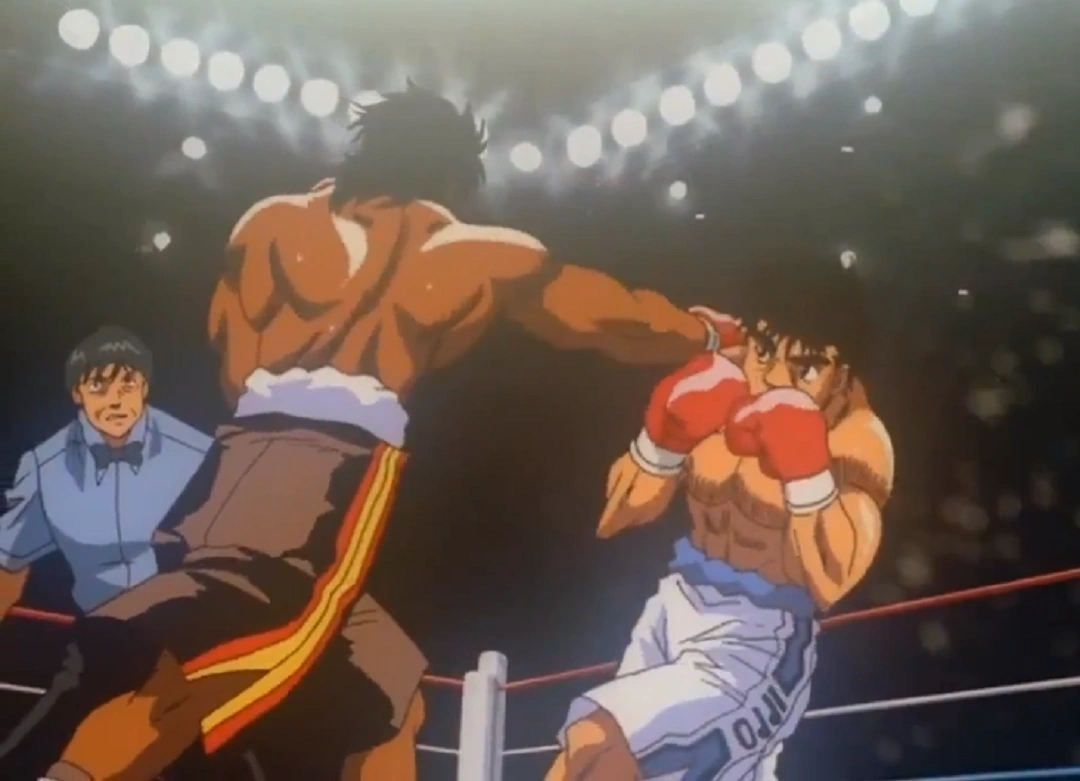

A boxing match.
Boxing is conducted in a regulated way, typically in a series of one to three-minute intervals called rounds. A boxer has up to three seconds with them at their corner, which is either red or blue. In the ring, only the two boxers and a referee can be inside during the match. After three minutes, the gong sounds, and a round is finished. After a round, the boxers go to their corner where their seconds are for one minute until "Seconds Out" is called so the next round can begin.
Boxing matches are set at a venue, and each match counts to their record. In a match, there is a three down rule, where if a boxer goes down three times in one round, the match ends in their loss by TKO. A boxer can not hit below the belt, or perform other fouls.
Boxers can challenge other boxers for their rank in order to get a better chance for a title match. Rankings change every month, resulting in rank changes without boxers fighting. If a highly ranked boxer hasn't had a match in a while or retires, their rank drops and another boxer gets ranked higher or the rank becomes vacant.
The amount of rounds depends on the type of boxing match:
- 4-Round Match - The round limit that new boxers start with after obtaining the Class-C License from the Pro-Test. Pro debuts are always four rounds. Tournaments such as the East Japan Rookie King Tournament and West Japan Rookie King Tournament are tournaments for Class-C licensed boxers and have a four round limit until the finals which is a six round match. Boxers who have fought four matches can move up to six round matches.
- 6-Round Match - The round limit for Class-B License boxers. The east and west Japan Rookie King tournament's finals and the All Japan Rookie King Tournament are six round matches. The Class A Boxer Prize Money Tournament can have six round matches. After two six round matches, the boxer can move up to eight round matches and is able to face against JBC rankers.
- 8-Round Match - The round limit for Class-A License boxers. The Class A Tournament can have eight round matches.
- 10-Round Match - JBC title matches and JBC ranker matches are ten round matches. The WBA, WBC, OPBF ranked matches can be ten rounds at the minimum.
- 12-Round Match - The WBA, WBC, OPBF, and IBF title matches are twelve round matches, while the ranked matches can be ten to twelve rounds.
- 15-Round Match - Previously, when boxing was called "prize-fighting", matches could go up to fifteen rounds. It was retired to prevent injuries.
Title Match
Title matches consist of the title holder called a champion defending their title against the challenger. To the champion, it is referred to a title defence match. Depending on the type of title match, they're ten to twelve round matches. If a title match ends in a draw, the champion keeps their title.
National Title Match
A national title match is where a boxer challenges the champion in their own country and is what many boxers aim for to the road to the world stage. Each country has their own ranking. Known countries with title matches are: Japan (JBC), Indonesia, Philippines, Mexico, and Thailand.
World Title Match
World title matches are title matches that boxers of any nationality can fight in for the world title. The four boxing organisations that have their own world ranking and title matches are WBA, WBC, IBF, and WBO. World title matches are said to be in a league of their own.[2] Both boxers and gym staff alike have a goal of partaking in a world title match.
Spar


A sparring match.
A spar is a practise match not set at a venue and does not affect the boxers' record. The rules can be up to the boxers or the gym's staff, with the spar consisting of any number of rounds, and the three down rule being on or off. There is usually only one second for each boxer. The match can be stopped at anytime for any reason.
Mass Boxing
Mass Boxing (マス・ボクシング, Masu Bokushingu) is a no-contact sparring match. It can be used to prevent any injuries in case a boxer has an upcoming match soon and to practise one's angle, timing, and distance of their punches.
Result
Victory is achieved if:
- Knockout (KO) - The opponent is knocked down and unable to get up before the referee counts to ten.
- Technical Knockout (TKO) - The opponent is deemed too injured to continue before the referee counts to ten, he may not even start to count.
- Decision - There is no stoppage of the fight before an agreed number of rounds, a winner is determined either by the referee's decision or by judges scorecards.
The match can end if one of the seconds on either side throws their towel into the ring, usually to save their fighter from life threatening injuries. The match can end in a disqualification if one of the boxers repeatedly perform fouls on their opponent after being warned. The match can end in a doctor stop if one of the venue's doctors deem it too risky to continue the match usually due to severe bleeding. The match can end in a draw if the match goes to decision and the points of both boxers add up to the same amount.